Roofing guides · Calgary

Ice Dam Prevention in Calgary: Why the Same Roofs Fail Every Winter

Ice dams come back to the same Calgary houses because the cause is heat loss, not weather. Here is the physics, why heat cables and roof raking only buy time, what fixes it for good, and how to get ice off safely.

Written by Johnny Anderson, owner of Mountain Standard Roofing Ltd. · Updated 2026-09-01

Some Calgary houses get an ice dam every single winter. Same eave, same corner over the garage, same stained ceiling in February. That is not bad luck — it is a heat-loss pattern in the roof that has never been corrected.

An ice dam is a ridge of ice at the cold edge of a roof, in the eavestrough or just above it. Once it is thick enough, meltwater coming down the roof has nowhere to go, so it ponds behind the ice and works sideways and upward under the shingles. Asphalt shingles are lap-shed products: they handle water running down, not water standing and pushing back up. That is how a roof with no broken shingles anywhere on it puts water in your ceiling.

The physics, in plain language

The National Research Council of Canada laid this out in Canadian Building Digest 89, Ice on Roofs: ice damming needs snow on a sloping roof, outside air below freezing, and a source of heat (or solar radiation) melting the snow from underneath. CMHC’s ice damming research reduces it to three ingredients:

  1. Snow on the roof.
  2. Upper roof areas at or above melting temperature.
  3. Lower roof areas below freezing.

Remove any one and you get no dam. The heat for ingredient two almost always comes from inside your house: warm air leaking through the ceiling into the attic, plus conducted heat through thin or gapped insulation. It warms the sheathing, the snow in contact with the deck melts, the water runs down to the overhang — which is not warmed by the attic and sits at outdoor temperature — and freezes there.

Natural Resources Canada adds the counter-intuitive proof: a completely uninsulated attic usually has no ice dams, because the roof is so warm snow melts as it lands and never accumulates. A well-sealed, well-insulated attic also has no ice dams, because the roof stays cold. It is the houses in between — partly insulated, leaky at the top plates — that dam up every year.

Why the same houses, every winter

Calgary makes it worse than most of Canada

We do not just freeze — we oscillate. The 1991–2020 normals for Calgary International Airport from Environment and Climate Change Canada show 138.7 cm of average annual snowfall, 61 days a year when the temperature never rises above 0 °C, and 193 days a year that fall below freezing. The overlap between those two counts is the dangerous part: roughly 130 days a year where the roof crosses the freezing point in a single day.

January at that station has recorded both 17.6 °C and −39.7 °C within the same 30-year normals period. A chinook does not clear the roof; it melts the snowpack from above while the eave stays frozen, then hands the water back to the ice. Every cycle grows the dam a little and drives a little more water under the shingles.

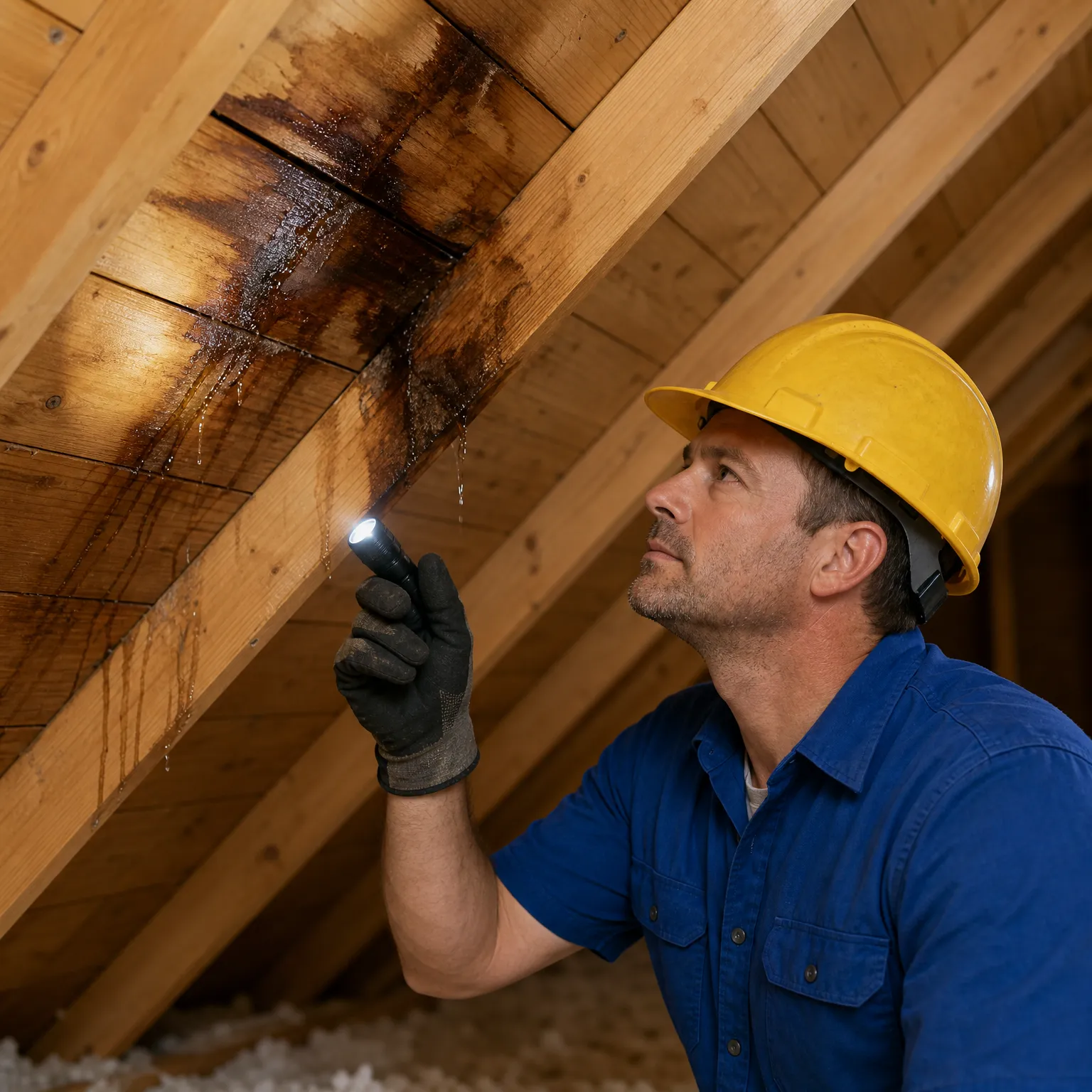
Roof repair work at the eave of a Calgary home after ice dam damage

Ice dam damage shows up at the eave first: soaked sheathing, rusted fasteners, and a drip edge that has been pried away from the deck.

The damage path

In the order it usually happens:

On the insurance side, the Insurance Bureau of Canada notes that policies commonly respond to sudden and accidental water damage, while ongoing or repeated damage is usually treated as a maintenance issue and may not be covered. Translation: the third winter of the same ice dam is your problem, not your insurer’s.

Why heat cables and roof raking are band-aids

CMHC is direct about it: snow rakes and electric cables attack ingredients one and three — the snow and the ice — and can reduce leakage in the short term, but because they do not address the melting and freezing, they often do not provide a long-term solution and do not stop the durability damage from ice buildup. Its conclusion: the best solution is to change attic conditions.

NRCan adds that heating cables burn a significant amount of electricity, look bad on most roofs, and are one of several “quicker solutions with drawbacks”.

To be fair, the City of Calgary does list de-icing cables and chemical de-icer as ways to manage persistent icing, and they have their place on an older roof where full correction is impossible. Use them as management, not as a repair — a cable melts a channel, it does not cool your roof.

What does not work at all

What actually fixes it, permanently

Make the roof deck cold and keep it cold. Same three steps, in this order:

  1. Air seal the attic floor. Top plates of interior and exterior walls, plumbing stacks, wiring, bath fan housings, chimney chases with a non-combustible fire stop, dropped ceilings, party walls, and a weatherstripped, insulated attic hatch. Every bath and kitchen fan gets ducted out through solid insulated metal duct with sealed joints, sloped to the outside, discharging clear of the soffit vents.
  2. Insulate to R-50–R-60, with the eave detail done right. CMHC’s floor is at least 300 mm of loose fill or batts. The part that stops ice dams is the outer edge: baffles in every truss bay, then the best insulation you can fit above the top plate — spray foam or extruded polystyrene held 25 mm off the sheathing with insulation packed behind it, as NRCan details. That is the core of an attic insulation upgrade.
  3. Confirm venting meets code. The National Building Code – 2023 Alberta Edition, in force provincially per the Government of Alberta, requires unobstructed vent area of at least 1/300 of the insulated ceiling area (1/150 for slopes under 1 in 6 or joist-framed roofs), with at least 25% of the openings high, at least 25% low, and 63 mm of clear space above the insulation.

When the roof is due anyway, this work is cheapest done together. At tear-off we can see and correct the eave: proper eave protection membrane — code requires it from the roof edge at least 900 mm up the slope and to a line at least 300 mm inside the inner face of the exterior wall — new drip edge, replacement of any rotten sheathing and fascia, and clean intake at the soffit. If the sheathing is soft, a residential roof replacement with the attic corrected in the same job is far cheaper than doing it twice.

Emergency removal, done safely

If water is coming in right now:

What NOT to do

How we approach it

We start in the attic, not on the roof, because that is where the cause is. Free inspection: frost and moisture readings, insulation depth, air-leak mapping, fan ducting, baffles, and vent area against the 1/300 requirement. Then the roof: eave, membrane, drip edge, sheathing, trough and fascia. You get a written scope in the correct order, roofing priced separately from attic work, with any active leak stabilised first through roof repair. If you are comparing quotes, bring us a written one for the same scope from another Calgary roofer and our $500 price-beat guarantee applies.

Talk to us

If you saw ice at your eaves last winter, the fix is a fall job, not a February emergency. Call Mountain Standard Roofing at (587) 577-6170 or book a free inspection. We cover Calgary, Airdrie, Chestermere, Cochrane, Okotoks, High River, Strathmore, Red Deer, Brooks and Claresholm — and you can read what neighbours say on our reviews page.

Questions homeowners actually ask

Straight answers

What causes ice dams on Calgary roofs?

Heat escaping into the attic. CMHC describes three required ingredients: snow on the roof, upper roof areas at or above melting temperature, and lower roof areas below freezing. Warm air leaking through your ceiling plus thin insulation warms the deck, snow melts, the water runs to the cold overhang and refreezes into a ridge of ice.

Do heat cables prevent ice dams?

They manage symptoms. CMHC found that cables and snow rakes can reduce leakage short term but often do not provide a long-term solution because they do not address the melting and freezing, and they do not stop the damage ice buildup causes. NRCan also notes cables use significant electricity. Air sealing and insulating is the permanent fix.

How do I get an ice dam off my roof safely?

Work from the ground with a roof rake to pull snow off the lower roof, protect the interior, and hire low-pressure steam removal for thick ice or anything over an entry. The City of Calgary's method for an existing dam is to make holes through the ice and place de-icer in each hole. Never chip at it and never climb an iced roof.

Can I use salt to melt an ice dam?

Do not spread rock salt or ice melter on shingles. It corrodes flashings, fasteners and eavestrough, harms plants below the eave, and CMHC notes corrosion and environmental damage even with the salt-in-a-stocking method. Calcium chloride tablets placed in drilled holes are a controlled last resort, not a maintenance plan.

Will ice and water shield stop ice dams?

No. Eave protection membrane is required by code on new shingle roofs, from the roof edge 900 mm up the slope to a line 300 mm inside the inner face of the exterior wall. Both CMHC and NRCan are clear that membrane does not prevent ice dams. It keeps backed-up water out of the sheathing while ice still damages shingles and eavestrough.

Does my home insurance cover ice dam damage?

Often for the first sudden event, not for repeat damage. The Insurance Bureau of Canada says standard policies commonly cover sudden and accidental water damage from ice dams, while ongoing or repeated damage is considered a long-term maintenance issue and may not be covered. Coverage varies, so check your own policy wording.

How much attic insulation stops ice damming in Calgary?

CMHC's minimum benchmark is at least 300 mm of loose fill or batts; we build Calgary attics to roughly R-50 to R-60. Depth alone is not enough, though. The eave detail matters more: baffles in every truss bay and the best insulation you can fit above the exterior wall top plate, installed after the ceiling is air sealed.

Sources

Want a real number for your roof?

We measure the roof, count the penetrations, look at the decking and give you a written quote with the scope itemised — free, no obligation. Bring us a written quote from another Calgary roofer for the same scope and we will beat it by $500.

Get your free estimate See our metal roofing work

★★★★★ 5.0 out of 5 — 10 Google reviews

Calgary homeowners rate us 5.0

Every review below is a verified Google review of Mountain Standard Roofing Ltd. Backed by our 10-year workmanship warranty and our $500 price-beat guarantee.

★★★★★

“Mountain Standard Roofing handled my storm damage roof replacement perfectly. They worked directly with my insurance company, handled all the paperwork, and made the entire process stress-free. The crew was professional, efficient, and left my yard clean.”

Nikki Rick — Google review

★★★★★

“John and his team were awesome to deal with. He did my roof and siding and they finished a day ahead of schedule. Not only was the service awesome but the price was much better than competitors.”

Kristoffer — Google review

★★★★★

“The owner John is very communicative and always took time to answer our questions. Our roof was re-done in the agreed timeline and for the agreed upon price. Would highly recommend doing business with Mountain Standard Roofing.”

Ryan Van Boven — Google review

Read all 10 reviews