Roofing guides · Calgary

Roof Replacement Cost in Calgary: The 2026 Price Guide

What a full roof replacement really costs in Calgary in 2026 — priced by home size in squares and by shingle grade, with every cost driver explained: pitch, storeys, tear-off layers, sheathing, ventilation, flashing and disposal.

Written by Johnny Anderson, owner of Mountain Standard Roofing Ltd. · Updated 2026-09-07

Roofing is sold by the square — one square is 100 square feet of roof surface. A Calgary bungalow with a 1,200 sq ft footprint does not have a 1,200 sq ft roof; add pitch, overhangs and a garage and it is closer to 18 squares. That gap is why online estimates are useless and why the first honest number comes from a measurement.

Below is what a full residential roof replacement actually costs in Calgary in 2026, broken out by home size and by shingle grade, plus every driver that moves the number.

Roof replacement cost in Calgary by home size — 2026

Calgary market ranges, not a quote. All figures are installed and include tear-off of one layer, synthetic underlayment, ice and water shield at eaves and valleys, new flashings, new vents, disposal and cleanup. GST not included.

Home typeTypical roof areaSquares3-tab asphalt
($4.40–5.60/sq ft)
Architectural asphalt
($5.20–7.20/sq ft)
Class 4 impact-resistant
($6.10–7.20/sq ft)
Small bungalow / semi-detached1,400 sq ft14$6,200 – $7,800$7,300 – $10,100$8,500 – $10,100
Bungalow with attached garage1,800 sq ft18$7,900 – $10,100$9,400 – $13,000$11,000 – $13,000
Typical two-storey2,000 sq ft20$8,800 – $11,200$10,400 – $14,400$12,200 – $14,400
Larger two-storey2,600 sq ft26$11,400 – $14,600$13,500 – $18,700$15,900 – $18,700
Large two-storey / estate home3,400 sq ft34$15,000 – $19,000$17,700 – $24,500$20,700 – $24,500

The most common Calgary job we quote is 18 to 24 squares in architectural asphalt, which lands between roughly $9,400 and $17,300. If someone quotes you $6,500 for a two-storey, something is missing from the scope — usually the tear-off, the ice and water shield, or the flashings.

Where metal fits

For comparison, on the same measured roof area: ribbed exposed-fastener steel runs $8–$12 per sq ft, stone-coated steel shingle $10–$17, and standing seam $12–$18. That puts a 20-square metal roof at roughly $16,000 to $36,000 depending on profile. The full breakdown, including lifespan and hail performance, is in our metal roof cost guide for Calgary.

Shingle grades — what you actually get for the money

3-tab asphalt

Single-layer, flat-profile shingle. It is the cheapest option and it is disappearing from Calgary for good reason: lower wind ratings, shorter service life, and it looks like what it costs. Expect 15–20 years here. Reasonable on a detached garage, a rental, or a house you are selling this year. Not reasonable on a hail-exposed principal residence.

Architectural (laminate) asphalt

Two laminated layers, heavier mat, dimensional shadow line. This is the Calgary standard and it is what goes on the overwhelming majority of homes we do. Expect 25–30 years of real service in this climate, with better wind and nail-pull performance than 3-tab. The $5.20–$7.20 per sq ft spread comes down to brand, profile, waste factor and how complicated the roof is.

Class 4 impact-resistant

Same laminate construction with a modified, more elastic asphalt or a polymer-modified (SBS) mat. To be labelled Class 4 a shingle must pass UL 2218 — a two-inch steel ball dropped twice from twenty feet onto the same spot without cracking, splitting or rupturing. In a hail city that is not a marketing badge, it is a functional difference. Many Alberta insurers offer a premium discount for Class 4; ask yours before you choose, because the discount can pay back the upgrade.

The City of Calgary’s climate projections expect potential convective precipitation days — the conditions that produce hail — to increase roughly 55% by the 2050s, with large hail events increasing in size. Class 4 is the cheapest insurance against that trend at about a dollar per square foot over standard architectural.

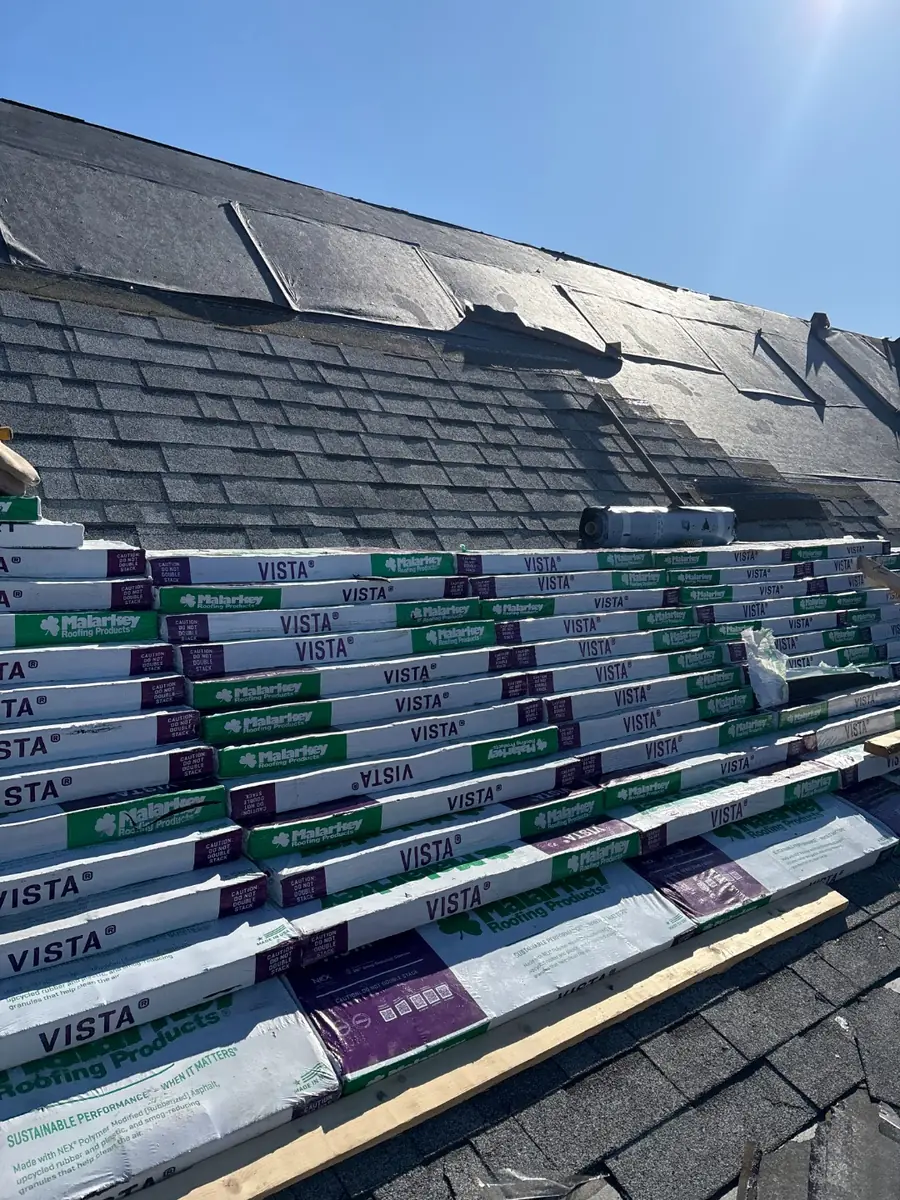
Malarkey Vista shingle bundles staged on a Calgary roof before installation

Bundles staged before install. Shingle grade sets the base price; the roof itself sets everything else.

Every cost driver, explained

Pitch

Up to about 6:12 a crew can walk the roof. From 7:12 up, they need roof jacks, planks and staging, and production drops. Expect roughly 10–15% added labour at 7:12–9:12 and 20–30% above 10:12. Steeper roofs also have more surface area than the footprint suggests, so both the quantity and the rate go up.

Storeys and access

A two-storey means longer ladders, more staging, a taller debris drop and slower material handling. A three-storey infill on a narrow lot with no rear lane access can add $1,000–$2,500 in handling alone. Tight side yards, mature trees, and landscaping that has to be protected all cost time.

Layers of tear-off

One layer is priced into the ranges above. A second layer typically adds $0.55–$0.95 per sq ft — roughly $1,100–$1,900 on a 20-square roof — because it is double the labour and double the tonnage to the landfill. Natural Resources Canada’s Keeping the Heat In guidance is blunt about this: when installing new shingles it is typically recommended to remove the existing ones, because adding a layer increases the load on the roof structure.

Sheathing replacement

You cannot know what is under the shingles until they are off. Budget for some. Typical Calgary rates run $95–$150 per 4x8 sheet of plywood or OSB, installed. Older homes with 1x6 board sheathing and spaced gaps often need full re-sheathing, which on a 20-square roof is $6,000–$9,500 on top of the roof. Get the per-sheet rate in writing before work starts — that is the single most common source of change-order disputes.

Ventilation

NRCan sets the working rule for a peaked roof with an accessible attic: an unobstructed vent area to insulated ceiling area ratio of 1 to 300, ideally with about 50% of that as continuous soffit intake and 50% as ridge, gable or roof vents. Most 1970s and 1980s Calgary homes are short on intake because insulation has been blown into the eaves. Correcting it means baffles, possibly new soffit venting, and $400–$1,500 in added scope. It is worth it — NRCan notes a well-sealed, well-insulated attic produces a cool roof and generally will not form ice dams.

Flashing

Chimneys, sidewalls, valleys, skylights, plumbing stacks and roof-to-wall transitions. Reusing old flashing to save $600 is how a $14,000 roof leaks in year three. Budget $550–$2,000 depending on how many transitions the house has. Skylight replacement, if the units are original, is $900–$2,200 each and is far cheaper done now than after the shingles are on.

Waste disposal

A 20-square asphalt tear-off produces roughly 4,000–5,000 lb of shingle waste. Bin rental and landfill tipping typically account for $600–$1,400 of the job. Two layers roughly doubles it.

Permits

Straight like-for-like re-roofing of a house in Calgary generally does not require a building permit. The City’s regulation bulletin RB06-040 lists re-roofing, eavestroughing and flashing among maintenance work that normally does not require one — but it also states clearly that re-roofing with a material heavier than the original, such as concrete tile over asphalt shingles, does require a permit because of the increased dead load. Going from asphalt to a heavier system is a permit conversation.

Why Calgary is harder on roofs than most of Canada

What the market is doing in 2026

Statistics Canada’s building construction price indexes show Calgary residential construction costs down 0.1% in the second quarter of 2026 — one of only three major centres to decline — while metal fabrications rose 2.1% nationally on tariff and supply-chain pressure. In plain terms: asphalt shingle pricing and labour have stabilized this year, but anything metal — flashing, drip edge, vents, eavestrough — is still climbing. If you are choosing between asphalt and metal, that spread is not narrowing.

How to read a Calgary roofing quote

  1. Measured squares stated, not "approx."
  2. Shingle brand, line and grade named, with the wind rating
  3. Underlayment type, and ice and water shield coverage in feet from the eave
  4. Number of tear-off layers included, and the rate for an extra layer
  5. Per-sheet sheathing replacement rate
  6. Vent count and type, plus soffit intake work if required
  7. All flashings listed as new, not reused
  8. Disposal, permit responsibility, and cleanup included
  9. Workmanship warranty term in writing — and ask whether an ARCA five-year Warranty Certificate is available, which covers owner-occupied homes up to 372 m² (4,000 sq ft) of finished roof area
  10. WCB coverage and liability insurance confirmed

Itemized: what a proper Calgary roof-replacement quote includes

The checklist above tells you what to look for. This is the full scope sheet. Every line below should appear on a complete Calgary roof-replacement quote, whether it is ours or anyone else’s. There are deliberately no dollar figures here: this table is about scope, not price. Two quotes can only be compared on price once they are priced against the same scope.

Line itemWhat it isWhy it matters in CalgaryRed flag if missing from a quote
Tear-off to deck & disposalRemoval of every existing layer of shingles, underlayment and old flashings down to bare sheathing, loaded to a bin and hauled to landfill.Many older Calgary roofs carry two layers. Natural Resources Canada advises removing existing shingles rather than layering over them because of the added structural load, and the ARCA shingle standard does not permit roofing over existing shingles.Quote says “overlay” or “roof-over”, or does not state how many layers are included and what an extra layer costs.
Deck inspection & re-sheeting allowanceWalking the bare deck for rot, delamination and soft spots, and a stated per-sheet rate for replacing bad plywood or OSB.On a reroof the ARCA standard requires plywood or OSB sheathing of at least 9.5 mm (3/8 in.), and new construction under the National Building Code – 2023 Alberta Edition (in force since May 2024) is thicker still. Homes with 1x6 board decking or thin 1970s sheathing often need work nobody can see until tear-off.No per-sheet rate, no mention of deck inspection, or the phrase “deck repairs extra” with no number attached.
Synthetic underlaymentA woven polymer sheet laid over the whole deck under the shingles as a secondary water barrier.Tear-resistant in Chinook winds during installation and does not wrinkle or absorb moisture the way felt does through freeze-thaw. It is also the layer that keeps the house dry if hail opens the shingles before an adjuster sees them.Underlayment not named, or “felt” or “15 lb paper” on a full replacement.
Ice & water shield at eaves, valleys & penetrationsSelf-adhering rubberized membrane bonded to the deck where water backs up or concentrates.The National Building Code requires eave protection on shingle roofs extending at least 900 mm up the slope and to at least 300 mm inside the inner face of the exterior wall; the exceptions (roofs steeper than 1 in 1.5, regions under 3,500 degree-days) do not apply to a typical heated Calgary house. It is the last defence against ice-dam leaks.Not listed, listed without a coverage width, or only “at eaves” with no mention of valleys and penetrations.
Starter stripA purpose-made first course with the sealant strip at the eave and rake edges.Chinook gusts lift the first course first. A proper starter seals the leading edge of every eave and rake shingle so wind cannot get under it.Not listed, or “cut shingles” used as starter on a Class 4 or lifetime-warranty roof.
Drip edgeL-shaped metal at eaves and rakes that carries water off the deck edge into the eavestrough.Protects the sheathing edge and fascia from the meltwater cycle and keeps ice from prying the first course.Not listed, or “reuse existing”. Existing drip edge is almost never reusable after tear-off.
Shingles (Malarkey Vista / Class 4 option)The field shingle, named by manufacturer and product line, with the impact class stated. We install Malarkey Vista, an architectural shingle with a Class 4 hail impact rating as our standard; other Class 4 products are available.Class 4 is the highest UL 2218 impact rating. An Alberta brokerage reports that many Alberta insurers offer a premium credit for a documented Class 4 roof, and that in parts of Calgary, Airdrie and Okotoks some may require Class 4 at renewal. The credit is not automatic; the insurer wants the product name and rating on the invoice.Shingle described only as “architectural” or “30-year” with no brand, line or impact class.
Ridge capPurpose-made ridge and hip shingles, thicker than field shingles and sized to cover a ridge vent.Ridges take the most wind and the most hail. Field shingles cut into caps crack at the bend in cold weather.“Cut caps” or no ridge line at all.
Ridge / roof vents & intake balancingExhaust vents at or near the ridge and confirmation that soffit intake is open and sufficient, with the count stated.The requirement is unobstructed vent area of at least 1/300 of the insulated ceiling area, roughly half low and half high. Unbalanced ventilation is behind most attic rain, frost and premature shingle failure in Calgary.Vents “as existing”, no count, or no mention of soffit intake.
Pipe boots / flashingsNew flashings at every plumbing stack, furnace and bathroom vent, and electrical mast.Rubber boots crack after a decade of UV and freeze-thaw. Reused boots are a top-three leak source on otherwise new roofs.“Reuse where possible” or no line for penetrations.
Step & counter flashing at walls & chimneysNew step flashing woven into each shingle course where the roof meets a wall, with counter flashing lapped over it at chimneys.The code calls for stepped flashing with at least a 75 mm head lap extending 75 mm up the wall. Dead valleys and roof-to-wall transitions are where drifted snow sits all winter.Flashings not itemized, or “reseal existing” on a full replacement.
Skylight flashing kitsManufacturer flashing kit for each skylight, or a written note on the skylight’s condition and a replacement option.A 20-year-old skylight on a new roof is the leak that gets blamed on the roofer. Better to decide now while the shingles are off.Skylights not mentioned even though the house has them.
Cleanup & magnet sweepDaily debris removal, protection of landscaping and siding, and a magnetic sweep of lawns, beds and driveway for nails.Calgary lots are tight and neighbours are close. The sweep is what keeps nails out of tires and bare feet.Not stated. Assume it is not happening.
Permit if requiredStatement of whether a permit is needed and who applies.Like-for-like shingle replacement in Calgary normally does not need a permit under City of Calgary bulletin RB06-040, but a heavier material or structural work does.Silence on permits when the scope changes the material or structure.
written workmanship coverageThe installer’s written guarantee on the installation, separate from the manufacturer’s shingle warranty.Manufacturer warranties do not cover installation errors, and installation is where most leaks come from. Mountain Standard Roofing gives 10 years on full replacements, in writing.Warranty term missing, verbal only, or the manufacturer warranty presented as if it covered labour.

How to compare two quotes line by line

Print both quotes and this table. Go down the fifteen lines and tick each one off against each quote. Where a line is missing, ask the contractor in writing whether it is included and at what price, and get the answer added to the quote before you sign. Where a line is present on both, check the specification matches: the same number of tear-off layers, the same ice and water coverage in metres from the eave, the same shingle brand and line, the same vent count, the same warranty term. Only when the two scopes match does the bottom line mean anything. Do the same for eavestrough and siding if they are part of the job.

Once the scopes match, bring us the other quote.Your written quote sets out the materials, installation scope and applicable warranty. Details in the section below or request a quote. Property managers and condo boards can find a tender checklist built on the same lines on our property management roofing page, and real estate agents who need a scope for a listing can use our realtor partner page.

Talk to us

Mountain Standard Roofing handles residential roof replacement across Calgary, Airdrie, Cochrane, Okotoks and High River. If your roof is hail-damaged, see hail damage and insurance work — we document the damage for your adjuster and handle the claim paperwork. If it is only a section that has failed, roof repair may be the smarter spend, and if the attic is part of the problem, attic insulation belongs in the same conversation. Weighing a longer-life option? Compare metal roofing. Photos of finished work are in the gallery and homeowner feedback is on our reviews page.

Book a free inspection and we will measure the roof, photograph what we find, and give you a written scope with the numbers broken out.Your written quote sets out the materials, installation scope and applicable warranty. Call (587) 577-6170 or request a quote.

Questions homeowners actually ask

Straight answers

How much does it cost to replace a roof in Calgary in 2026?

Most Calgary homes land between $9,400 and $17,300 for architectural asphalt, which covers an 18 to 24 square roof at $5.20 to $7.20 per square foot installed. A typical 2,000 square foot two-storey roof runs about $10,400 to $14,400. Small bungalows start near $7,300 and large two-storey homes can reach $24,500. Those figures include tear-off, underlayment, flashings, vents and disposal.

What is a roofing square and how many does my house have?

One roofing square is 100 square feet of roof surface. Your roof area is not your floor area. A bungalow with a 1,200 square foot footprint typically has 16 to 18 squares of roof once pitch, overhangs and the garage are counted. A two-storey home with the same footprint may have fewer squares than the bungalow because the footprint is smaller relative to the living space.

Do I need a permit to replace my roof in Calgary?

Generally no for a like-for-like shingle replacement. City of Calgary bulletin RB06-040 lists re-roofing, eavestroughing and flashing as maintenance work that normally does not require a building permit. However, re-roofing with a material heavier than the original, such as concrete tile over asphalt, does require a permit because of the added dead load on the structure.

Are Class 4 impact-resistant shingles worth it in Calgary?

In a hail city, usually yes. Class 4 means the shingle passed UL 2218, where a two-inch steel ball is dropped twice from twenty feet onto the same spot without cracking. The upgrade costs roughly a dollar per square foot over standard architectural, about $2,000 on a typical roof, and many Alberta insurers offer a premium discount that shortens the payback. Ask your insurer first.

How much does sheathing replacement add to the cost?

Budget $95 to $150 per installed 4x8 sheet of plywood or OSB in Calgary. On most roofs only a handful of sheets are bad. On older homes with 1x6 board sheathing, full re-sheathing on a 20 square roof runs $6,000 to $9,500 on top of the roof price. Always get the per-sheet rate in writing before work starts, because nobody can see under shingles.

Does a second layer of shingles cost more to tear off?

Yes. A second layer typically adds $0.55 to $0.95 per square foot, roughly $1,100 to $1,900 on a 20 square roof, because it is double the labour and double the landfill tonnage. Natural Resources Canada recommends removing existing shingles rather than layering over them, since an added layer increases the load carried by the roof structure.

What should be listed on a Calgary roof replacement quote?

At minimum: tear-off with the number of layers included, deck inspection with a per-sheet re-sheeting rate, synthetic underlayment, ice and water shield with the coverage stated at eaves, valleys and penetrations, starter strip, drip edge, the shingle by brand and line with its impact class, ridge cap, vent count with soffit intake confirmed, new pipe boots and flashings, step and counter flashing at walls and chimneys, skylight kits, cleanup and magnet sweep, permit responsibility and the workmanship warranty term in writing. If any of these are missing, ask before you sign.

Is ice and water shield required by code in Calgary?

Yes for a typical house. The National Building Code requires eave protection on shingle roofs extending at least 900 mm up the slope from the edge and to a line at least 300 mm inside the inner face of the exterior wall. The exceptions are unheated garages and porches, overhangs deeper than 900 mm, very steep roofs over 1 in 1.5, low-slope installations and regions with 3,500 or fewer degree-days, none of which describe a heated Calgary home. Any full replacement quote should state the ice and water coverage in metres from the eave, plus valleys and penetrations.

How long does a Calgary roof replacement take?

It depends on roof size, pitch, the number of valleys, skylights and chimneys, whether any sheathing or ventilation needs correcting, and the weather. We give you a written schedule with your quote, book a single continuous window so the roof is never left open overnight, and tell you right away if rain moves a stage. Calgary's practical shingle season runs from spring through late October.

Sources

Want a real number for your roof?

We measure the roof, count the penetrations, look at the decking and give you a written quote with the scope itemised — free, no obligation.Your written quote sets out the materials, installation scope and applicable warranty.

Get your free estimate See our metal roofing work

★★★★★ 5.0 out of 5 — 10 Google reviews

Calgary homeowners rate us 5.0

Every review below is a verified Google review of Mountain Standard Roofing Ltd. Every job comes with a lifetime workmanship warranty and a clear written scope.

★★★★★

“Mountain Standard Roofing handled my storm damage roof replacement perfectly. They worked directly with my insurance company, handled all the paperwork, and made the entire process stress-free. The crew was professional, efficient, and left my yard clean.”

Nikki Rick — Google review

★★★★★

“John and his team were awesome to deal with. He did my roof and siding and they finished a day ahead of schedule. Not only was the service awesome but the price was much better than competitors.”

Kristoffer — Google review

★★★★★

“The owner John is very communicative and always took time to answer our questions. Our roof was re-done in the agreed timeline and for the agreed upon price. Would highly recommend doing business with Mountain Standard Roofing.”

Ryan Van Boven — Google review

Read all 10 reviews